

EBN Subsidiary Appointed as the Netherlands’ National Heat Investor
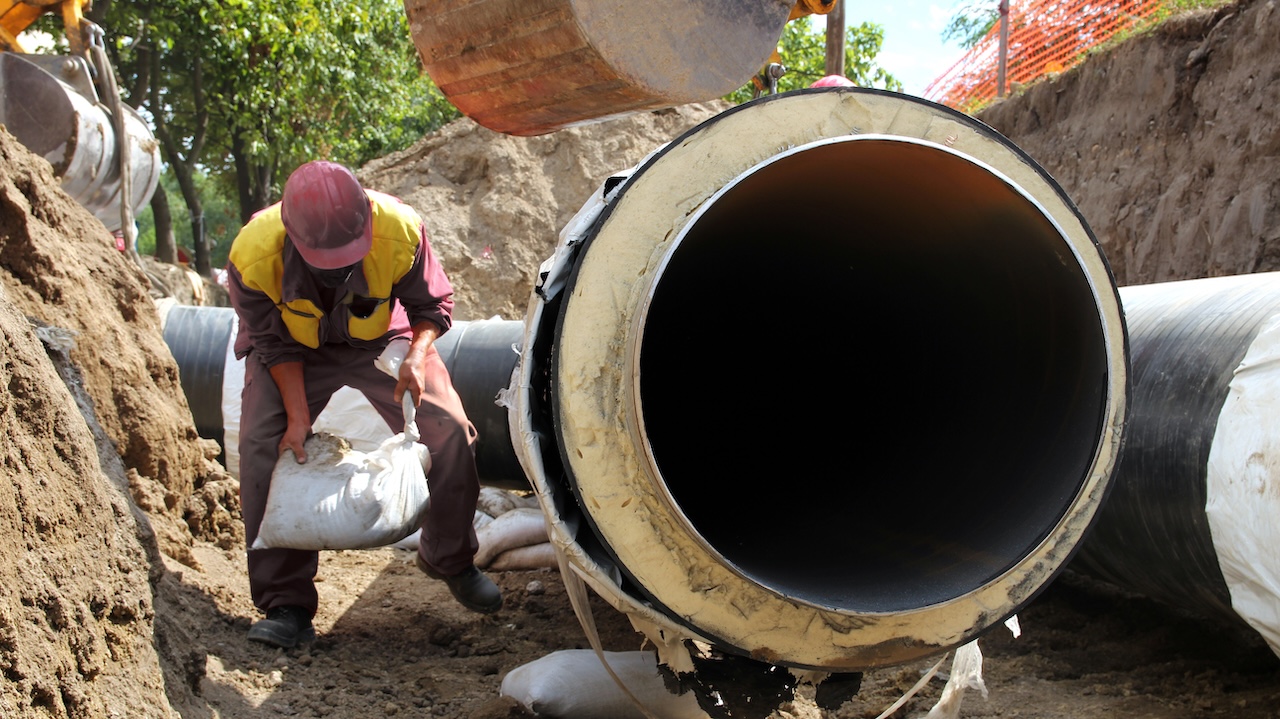
Backed by a formal designation from the Minister of Climate and Green Growth, EBN’s new subsidiary NDW B.V. will take on its role as the National Heat Investor (Nationale Deelneming Warmte – NDW). What can public partners such as municipalities, provinces and network operators expect from this new public investor in collective heat infrastructure?
Since 2024, Herman Exalto and Mark Hooftman have been leading the development of the National Heat Investor. They answer a number of frequently asked questions about the new public investor in collective heat systems and how it will contribute to accelerating the Dutch heat transition.
First of all, when will the National Heat Investor begin operating?
Herman Exalto, Programme Director National Heat Investor at EBN:
“We will officially launch on 1 July 2026. Unofficially, we have already spent the past eighteen months building the foundations of the National Heat Investor. In 2025, this resulted in six letters of intent for future heat companies. We expect several of these to develop into cooperation agreements this year. It is even possible that we will establish the first new heat company in 2026. Overall, we are off to a flying start.”
Why is the Collective Heat Act relevant to the designation?
Mark Hooftman, Project Manager National Heat Investor at EBN:
“EBN has a long history in mining-related activities. Until now, all EBN activities have been carried out under the Dutch Mining Act. Heat networks, however, are located only a few metres below ground and clearly do not fall under mining legislation. That is why a separate policy participation, the National Heat Investor, is required under the Collective Heat Act to invest in heat networks on behalf of the Dutch State. The National Heat Investor has been placed within EBN to enable a rapid start.”
How much can the National Heat Investor invest in heat networks?
Herman:
“Under the 2025 Spring Memorandum, €224 million has been allocated to the National Heat Investor for the coming five years. That figure does require some context. The funding is intended exclusively for investments in the public heat value chain, from source to network. It is not intended, for example, to acquire the heat activities of companies such as Vattenfall or Eneco. The clear objective is to use this funding over the next five years to establish new regional public heat companies together with municipalities and provinces, and subsequently enable the first heat projects developed by these organisations.”
Is €224 million sufficient to achieve the long-term ambitions for heat?
Mark:
“The €224 million is intended to support the first public heat companies currently being developed and their initial projects during the coming five years. For the longer term, these resources alone will not be sufficient.
Achieving the ambition of connecting approximately two to two-and-a-half million households by 2050 will require an estimated €80 to €90 billion across the entire heat value chain. We expect around €2 billion of that total to be invested through the National Heat Investor.”
Herman:
“The remaining funding will partly come from other public partners. A substantial share will need to come from debt financing. That is why it is important for the new public heat companies to quickly achieve sufficient scale, enabling them to attract external financing and support further investments.”
Will the National Heat Investor invest in heat sources as well as networks?
Mark:
“We invest in heat companies that take an integrated value-chain approach. This means considering not only how and where a network is developed, but also the heat source strategy. Where economically justified or necessary, investments can be made in both heat sources and heat infrastructure, including customer connections. Naturally, the required mix of heat sources will differ from one service area to another.”
Herman:
“It is important to emphasise that, in its role as National Heat Investor, EBN is technology-neutral regarding heat sources. We will always assess the most suitable source mix for each network or concession area. This may include aquathermal energy, residual heat or, where subsurface conditions allow, geothermal energy.
Decisions on additional investments in heat sources will depend on which source mix provides the optimal balance of affordability, reliability and sustainability.”
Do EBN’s geothermal energy activities fall under the National Heat Investor?
Herman:
“No. EBN’s geothermal activities are carried out under a separate mandate derived from the Dutch Mining Act. In addition, geothermal projects are public-private projects operating within a commercial market.
As the National Heat Investor, we focus on public partnerships within a strongly regulated public market governed by the Collective Heat Act. For this reason, and because financing streams must remain separate, the National Heat Investor operates independently from EBN’s geothermal portfolio.
We do, however, share a common objective: accelerating the deployment of affordable, sustainable and reliable heat solutions in the Netherlands.”
Is generating profit a primary objective for the National Heat Investor?
Mark:
“First and foremost, we view heat as a public utility. Our objective is not profit maximisation but the achievement of public value. For us, the ultimate success of the National Heat Investor would be the delivery of affordable, reliable and sustainable district heating solutions for roughly one-third of Dutch households. Achieving that will require substantial investment over the coming ten to fifteen years. As a public shareholder in regional heat companies, we provide patient capital that ultimately needs to generate returns. However, we fully recognise that this requires a long-term perspective rather than a focus on short-term financial gains.”
What ownership stake do you expect to hold in heat companies?
Herman:
“This will vary depending on the partnership, but we intend to play a substantial role as shareholder, typically holding between 30% and 40%. For local commitment and public support, it is essential that participating municipalities and/or provinces also become shareholders. This is not primarily about sharing financial obligations but about recognising their statutory responsibility to steer the heat transition through heat planning and the designation of concession areas. Local and regional authorities also represent the interests of residents within the governance of the heat company.”
Can any municipality approach the National Heat Investor to establish a heat company?
Mark:
“In principle, any municipality or province can approach us when considering the establishment of a public heat company. We are happy to help address the associated challenges. However, a key condition for our participation as shareholder is that a new heat company operates at a regional scale, involving multiple municipal shareholders or a provincial shareholder.”
Herman:
“That focus on regional scale is explicitly embedded in our mandate. A regional heat company benefits from economies of scale, which helps reduce costs and safeguard affordability for end-users.
For that reason, we cannot participate in initiatives that have no realistic prospect of becoming regional in scope. We therefore encourage municipalities to explore opportunities within regional energy partnerships and to involve us, as well as other public stakeholders such as network operators, at an early stage.”
What is not part of the National Heat Investor’s role?
Herman:
“It is important for municipalities to understand that the National Heat Investor will not act as an advisor on municipal heat policy, such as the development of local heat programmes. Organisations such as NPLW are highly specialised in that field. Our added value lies in helping to establish strong regional heat companies and facilitating knowledge sharing between the companies in which we participate. This includes expertise on technical solutions, financing structures and standardisation.”
Will the National Heat Investor only participate when a network operator is involved?
Mark:
“That is not a requirement. However, network operators are often natural partners because they are closely involved in decisions on how neighbourhoods move away from natural gas. Should a neighbourhood be electrified using heat pumps, or connected to a district heating network? What approach delivers the greatest public value? Issues such as electricity grid congestion also influence these decisions. That is why network operators and the National Heat Investor frequently find themselves working alongside municipalities and provinces as partners.”
Herman:
“We are both public organisations operating at arm’s length from politics. We also share a common interest in scaling up and improving cost efficiency. Although our paths do not cross in every project, there are many situations where cooperation is beneficial. Where appropriate, we are very willing to work alongside network operators.”
Finally, will the National Heat Investor play a role in the possible acquisition of private heat companies?
Herman:
“The short answer is yes. The longer answer is that the Minister of Climate and Green Growth currently leads this process, while EBN, in its role as National Heat Investor, is involved in an advisory capacity. The acquisition of private heat companies could be important for regaining momentum in the heat transition. These companies already operate heat networks in areas where society wants to see further growth of district heating. In addition, ownership would provide access to cash flows that could help finance future investments under more favourable conditions, reducing the need for additional government funding.”
Mark:
“Another advantage is that these companies already have operational processes and expertise in place. If these capabilities can be deployed in the broader heat transition, they could act as a catalyst for the rollout of public heat networks. They also employ many highly skilled and motivated professionals whose expertise would remain available to the sector. In short, a potential acquisition could accelerate both the deployment of public heat networks and the wider heat transition.”