




What is CO₂? Understanding carbon dioxide
Carbon dioxide (CO₂) occurs naturally in the atmosphere and plays an essential role in sustaining life on Earth. At the same time, it is one of the main drivers of climate change. On this page, you can learn what CO₂ is, where it comes from, why it matters, and how we can reduce the amount of CO₂ in the atmosphere.
What is CO₂?
What exactly is CO₂? CO₂ is the chemical abbreviation for carbon dioxide, also known as carbon dioxide gas. A CO₂ molecule consists of one carbon atom and two oxygen atoms. CO₂ can exist in solid, liquid, and gaseous states. In practice, it is most commonly found as a colourless and odourless gas.
When carbon dioxide is cooled significantly, it changes from a gas into a solid. At a temperature of -78°C, CO₂ freezes and resembles ice. When this solid form warms up again under normal atmospheric pressure, it does not first become a liquid. Instead, it changes directly back into a gas, a process known as sublimation. Under higher pressure, however, CO₂ can exist in a liquid state.
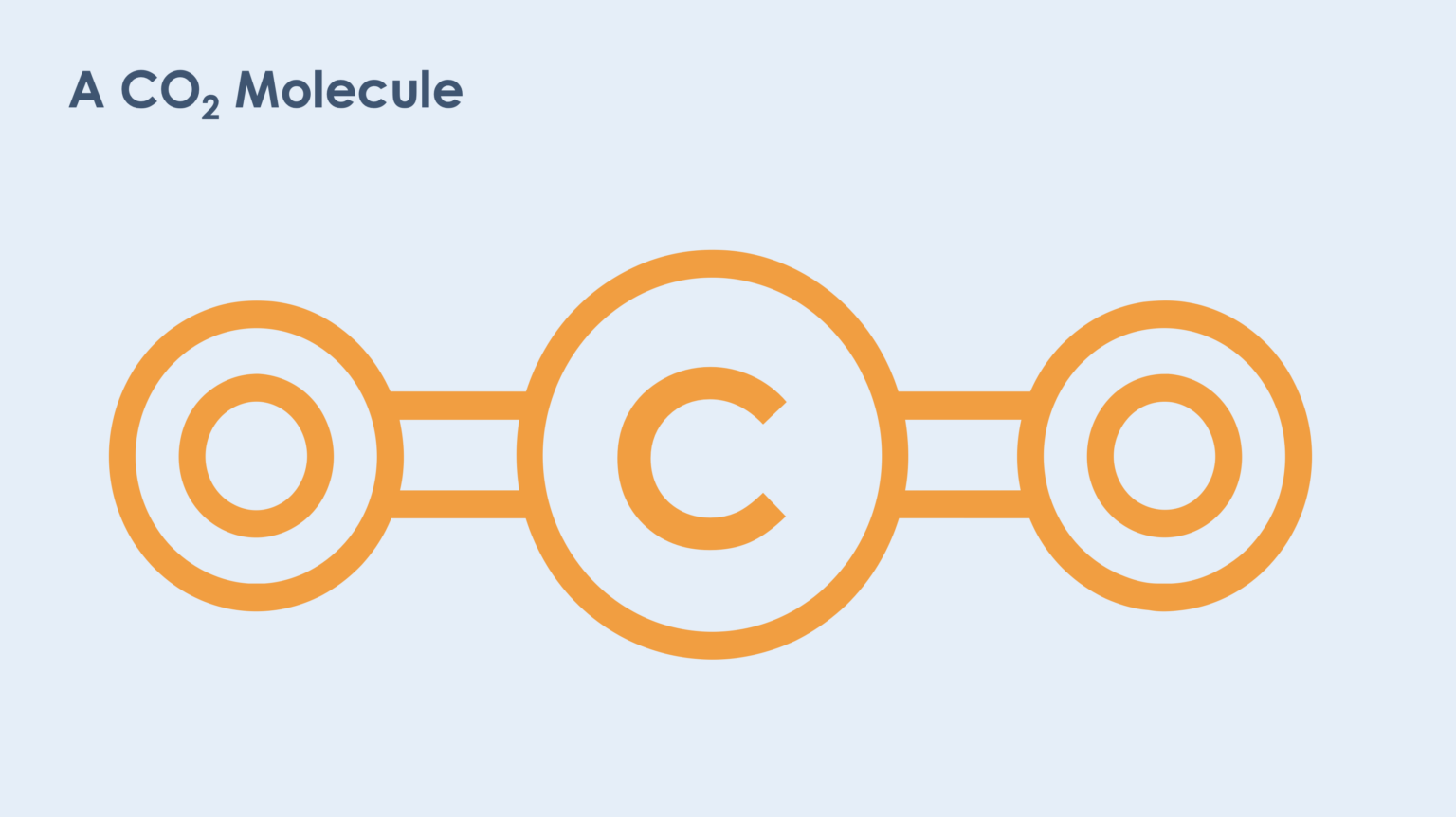 Carbon dioxide (CO₂) is a compound of carbon and oxygen. A CO₂ molecule consists of one carbon atom and two oxygen atoms: O=C=O.
How is CO₂ formed?
Gaseous CO₂ is released through the complete combustion of carbon-containing fuels. Carbon is found in fossil fuels such as coal, crude oil, and natural gas. As a result, CO₂ is emitted when fossil fuels are burned in vehicles, ships, aircraft, and industrial facilities. This is known as fossil CO₂ and is the result of human activity. These emissions are a major contributor to the increasing concentration of CO₂ in the atmosphere.
Carbon also occurs naturally in the environment, for example stored in trees, plants, and soils. When these natural sources burn or decompose, they release CO₂ as well. This is known as biogenic CO₂. Examples include forest fires and volcanic eruptions. In addition, humans and animals naturally produce CO₂ through respiration.
Both fossil and biogenic CO₂ are part of the global carbon cycle. However, the large-scale release of fossil CO₂ adds carbon that has been stored underground for millions of years to the atmosphere, contributing to rising atmospheric CO₂ concentrations and climate change.
Is CO₂ toxic?
CO₂ occurs naturally in the Earth’s atmosphere. The normal concentration of CO₂ in air is approximately 0.04%. Humans and animals can breathe this concentration without any adverse effects.
At higher concentrations, however, CO₂ can become harmful. Exposure to concentrations of around 1% may cause symptoms such as drowsiness or reduced concentration. At higher levels, people may experience headaches, shortness of breath, and dizziness. In very high concentrations, CO₂ can be dangerous and may even be fatal.
Because CO₂ is colourless and odourless, elevated concentrations cannot be detected by human senses alone. This is why industries that handle CO₂ use monitoring systems and safety procedures to protect workers and surrounding communities. While CO₂ is not toxic in the traditional sense, high concentrations can reduce the amount of oxygen available in the air, posing a serious health risk.
Is CO₂ broken down by nature?
Nature helps remove CO₂ from the atmosphere. Plants and trees absorb CO₂ and convert it into carbon and oxygen through photosynthesis. The carbon is used for growth, while the oxygen is released back into the air. The oceans also absorb a significant amount of CO₂ from the atmosphere.
This natural process is part of the carbon cycle, in which carbon continuously moves between the atmosphere, plants, oceans, soils, and living organisms. Through this cycle, CO₂ is constantly exchanged between natural systems.
However, human activities currently release more CO₂ into the atmosphere than natural systems can absorb. As a result, CO₂ concentrations in the atmosphere continue to rise, contributing to climate change. Reducing emissions and increasing the capacity to remove or store CO₂ are therefore important parts of addressing climate change.
What is the impact of CO₂ on the climate?
CO₂ is an important greenhouse gas. This means it helps retain heat in the atmosphere. Without CO₂, the Earth would be too cold to support life.
However, human activities are now releasing so much CO₂ that the natural balance is being disrupted. Every day, more CO₂ accumulates in the atmosphere than natural systems can absorb. As a result, the greenhouse effect is intensified, leading to climate change. We can see its effects in rising temperatures, changing weather patterns, shifts in precipitation, and more frequent extreme weather events.
A useful way to think about this is to imagine a bathtub filled with water. If the bathtub is already full and you keep adding water, it will eventually overflow. The same principle applies to CO₂ in the atmosphere. To address climate change, we need to turn off the tap by preventing additional CO₂ emissions, while also lowering the water level by reducing the amount of CO₂ that is already present in the atmosphere.
Reducing emissions through renewable energy, energy efficiency, and industrial decarbonisation is therefore essential. At the same time, solutions such as Carbon Capture and Storage (CCS) and Carbon Dioxide Removal (CDR) can help prevent additional CO₂ from entering the atmosphere and remove existing CO₂, supporting the transition to a climate-neutral future.
How can we reduce CO₂ emissions?
Industries can reduce their CO₂ emissions through electrification or by switching fuels, for example replacing natural gas with green hydrogen. However, for sectors such as heavy industry, aviation, and agriculture, this transition is not progressing quickly enough and residual emissions are expected to remain. As a result, industrial carbon management is essential to achieving climate goals.
Industrial carbon management includes:
- Carbon Capture and Utilisation (CCU)
- Carbon Capture and Storage (CCS)
- Carbon Dioxide Removal (CDR)
Captured CO₂ can be reused in a variety of applications, such as the food and beverage industry (for example, the carbonation in soft drinks), greenhouse horticulture, or the production of synthetic fuels. This is known as Carbon Capture and Utilisation (CCU).
With Carbon Capture and Storage (CCS), CO₂ is captured from industrial processes and permanently stored underground. This can involve both fossil CO₂ and CO₂ of biogenic origin, such as emissions from biomass-fired power plants.
When fossil CO₂ is permanently stored, it is referred to as CCS. When biogenic CO₂ is permanently stored, the process results in the removal of CO₂ from the atmosphere and is therefore classified as Carbon Dioxide Removal (CDR). Together, these approaches can help reduce emissions from hard-to-abate sectors and support the transition to a climate-neutral economy.