




The role of industrial carbon management in CO₂ emissions reduction
Industrial carbon management helps reduce CO2 emissions in sectors where (timely) decarbonisation is challenging. This is achieved through technologies such as CO2 capture and storage (CCS), utilisation (CCU) and removal (CDR). In this way, industrial carbon management contributes to achieving climate goals.
What is industrial carbon management?
To limit climate change, both the amount of CO2 in the atmosphere and CO2 emissions to the atmosphere must be significantly reduced. However, completely preventing CO2 emissions is particularly complex in sectors such as heavy industry and aviation. Industrial carbon management contributes to the solution by capturing and storing CO2 (CCS), reusing it (CCU), or removing it (CDR).
What is Carbon Capture and Storage (CCS)?
In CCS, CO2 is captured from industrial facilities and, after transportation, safely stored deep underground. The aim is to reduce emissions by preventing CO2 from entering the atmosphere.
In the Netherlands, depleted gas fields beneath the Dutch sector of the North Sea are used for CO2 storage. The CO2 is stored in the pores of the sandstone where natural gas was previously present. This gas remained hermetically sealed for millions of years by the sealing rock layer above the reservoir (also known as the “caprock”) and the sealing structures at the sides.
-
How does CCS work?
The process of CO2 storage starts with industrial processes. Here, the CO2 emitted by industry is captured before it enters the atmosphere. This includes both fossil CO2 (from heavy industry) and CO2 of biogenic origin (from biomass power plants). It may also involve a mixture of fossil and biogenic CO2, such as at waste-to-energy plants. The CO2 is then compressed at a compressor station to make it suitable for transport.
The CO2 is subsequently transported via a pipeline or by ship to a platform in the North Sea. From this platform, the CO2 is injected into a depleted gas field through dedicated injection wells. These wells consist of strong steel casings that are securely cemented into the surrounding rock. Monitoring equipment installed in the well measures pressure and temperature during CO2 injection. Once CO2 injection has ended, when the reservoir is full and has reached the appropriate final pressure, the wells are permanently and hermetically sealed using a large cement plug.
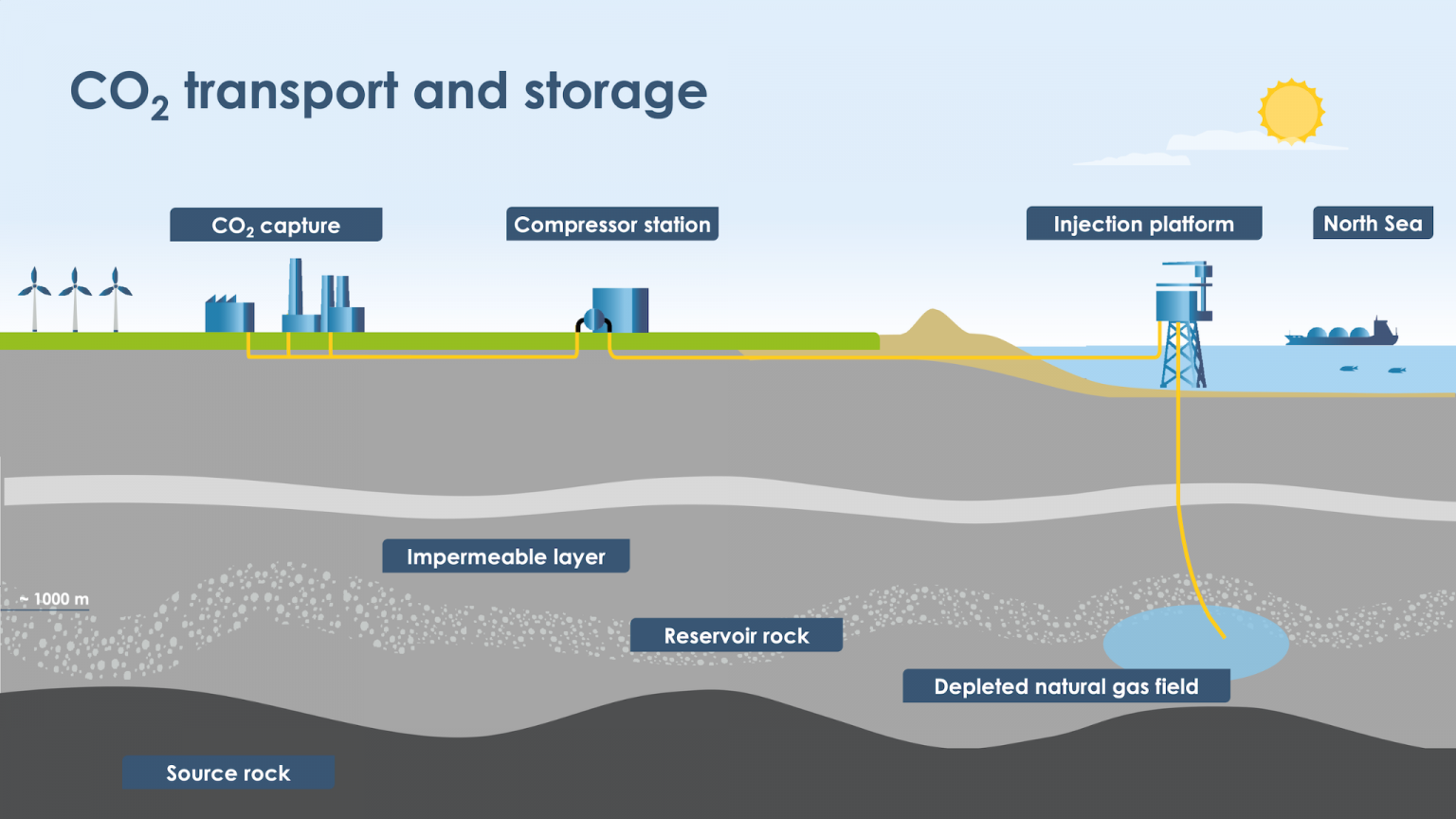 How CO₂ is captured, transported and permanently stored deep underground beneath the North Sea.
-
EBN’s role in CCS
EBN is actively involved in the development of CO2 storage beneath the Dutch sector of the North Sea. We work together with public and private parties involved in the delivery of CCS in the Netherlands. As a partner, we participate in the CO2 transport and storage projects Porthos and Aramis, as well as in other projects that enable CO2 storage beneath the North Sea. In addition, EBN develops and shares knowledge on CO2 storage.
What is Carbon Capture and Utilisation (CCU)?
In CCU, CO2 is captured and subsequently reused, for example as a feedstock in industrial processes or for the production of synthetic fuels.
-
How does CCU work?
When CO2 is reused, a distinction is made between short-term and long-term utilisation. Examples of short-term utilisation include:
-
- Use in food products (for example, the carbonation in soft drinks)
- Use in greenhouse horticulture (as a feedstock for growth)
- Use in industrial processes (for example, for the production of fertilisers)
- Use for synthetic fuels (for example, synthetic kerosene)
Examples of long-term utilisation include:
-
- As a feedstock for cement-based construction materials
- Use in timber construction
-
EBN’s role in CCU
CCU is one of the technologies that contribute to emissions reductions. Although EBN is not directly involved in CCU projects, many of EBN’s stakeholders are. For this reason, EBN closely follows developments in this area, for example through the Platform Carbon Management.
What is Carbon Dioxide Removal (CDR)?
CDR involves capturing and removing CO2 that is already present in the atmosphere. Carbon removal leads to negative emissions, an important complement to other ways of reducing emissions and essential for addressing historical emissions and achieving climate goals.
-
How does CDR work?
Within CDR, a distinction is made between temporary and permanent storage. Temporary storage occurs, for example, in newly planted forests and soils. Permanent removal involves extracting CO2 from the atmosphere and storing it safely and irreversibly. This can take place in the deep subsurface, in depleted gas fields and in aquifers (water-bearing formations in the deep subsurface).
There are various technologies for removing carbon from the atmosphere.
The best-known example of permanent carbon removal is Bio-Energy with Carbon Capture and Storage (BECCS). In this process, biomass is used to generate energy, after which the released CO2 is captured and permanently stored underground. Because the biomass has removed CO2 from the atmosphere, this results in carbon removal.
Another example is mineralisation, whereby captured CO2 is converted into solid rock through a chemical process.
Other technologies include Direct Air Capture (DAC), in which CO2 is filtered from the air using chemical substances and subsequently stored, and Direct Ocean Capture (DOC), in which CO2 is filtered from seawater. When CO2 captured through DAC or DOC is stored permanently, this constitutes permanent CO2 removal.
-
EBN’s role in CDR
EBN considers the permanent geological storage of biogenic CO2 to be a crucial element in achieving negative emissions. For this reason, we are represented in various platforms that aim to increase awareness of the importance of removing CO2 from the atmosphere. For example, we participate in the Platform Carbon Management, which works to strengthen policy by highlighting regulatory and implementation barriers and contributing to a coherent vision for the use of CO2. We are also part of the Dutch Carbon Removal Pact, which brings together partners from industry, government, academia and society to support the responsible development of negative emissions.