




EBN's role in CO₂-transport and -storage
CO2 transport and storage plays a crucial role in achieving the Netherlands’ climate goals. As an adviser to the Ministry of Economic Affairs and Climate Policy, Energie Beheer Nederland (EBN) works with public and private partners on CO2 storage beneath the North Sea and the development of scalable CCS solutions. EBN fulfils a range of roles in the CCS market, including joint venture partner, investor, de-risker, connector and knowledge partner.
CO2-transport and -storage in the Netherlands
The Netherlands is working towards a CO2-neutral future. In addition to the growth of renewable energy, however, additional solutions are needed to reduce emissions sufficiently to achieve the climate goals. This is necessary to prevent further climate change. CO2 transport and storage is indispensable in this regard, particularly for industries where the transition to more sustainable operations requires more time, such as the chemical, steel and cement industries.
CO2 transport and storage involves capturing CO2 from industrial sources, transporting it by pipeline or ship, and storing it in depleted gas fields several kilometres beneath the North Sea. These fields are suitable because they have contained natural gas for millions of years and can therefore also store CO2 safely.
Capturing, transporting and storing CO2, also known as Carbon Capture and Storage (CCS), is an indispensable complementary measure in the energy transition. It enables companies to reduce their CO2 emissions quickly while simultaneously working on the structural decarbonisation of their processes.
EBN plays a leading role in the development of the CCS market and in the delivery of CO2 transport and storage projects. We are one of the largest investors in Dutch CCS initiatives and act as both project developer and business developer. In addition, we actively develop and share knowledge within the sector, both in the Netherlands and internationally. EBN therefore fulfils a variety of roles in this field.
EBN's roles in CO₂-transport and -storage
EBN is actively involved in the development of CO2 transport and storage beneath the Dutch sector of the North Sea. We do this as an advisor to the Ministry of Economic Affairs and Climate Policy and in support of the implementation of Dutch climate and energy policy. In this capacity, we play a central role in public-private partnerships focused on delivering CCS projects in the Netherlands.
As a publicly-owned organisation, we have a responsibility to serve the broader public interest. This means ensuring that new systems are safe, scalable, and designed for the long term. With more than fifty years of experience in subsurface energy activities, EBN has the expertise and experience required to develop projects safely and in a future-proof manner.
In addition to our advisory role, we actively contribute to the development of CCS projects in the Netherlands. EBN is one of the largest public investors in CO2 transport and storage in the Netherlands and plays an important role in launching new initiatives, including new storage sites.
We act as both project developer and business developer. This means we help turn projects from initial concepts into operational reality. We provide financial investment and contribute expertise in the subsurface, project structuring, and risk management.
EBN is also a partner and shareholder in key CO2 transport and storage projects. We participate in large-scale transport infrastructure projects such as Porthos and Aramis, as well as in more than ten storage fields beneath the North Sea. In this role, we contribute to the development of transport infrastructure, including pipelines, terminals, and hubs, facilitate access to depleted gas fields under the North Sea, and help ensure that the different links in the CO2 transport and storage value chain are effectively connected.
EBN develops and shares knowledge to make CO2 transport and storage as safe, efficient, and cost-effective as possible. One of the most important public platforms for knowledge exchange within the carbon management value chain is the annual Carbon Storage Dialogues. As part of this initiative, we publish ‘CO2 in Figures’ each year, an infographic providing an up-to-date overview of key CO2 facts and figures at the Dutch, European, and global levels. ‘CO2 in Figures’ is derived from the annual Energy in Figures infographic, which EBN has published since 2016.
In addition, we invest significant time and resources in research, expanding subsurface knowledge, and developing monitoring tools. One example is Calysto. This software enables the modelling and prediction of the behaviour of CO2 molecules throughout the entire value chain. Read more about Calysto here.
We have brought together all our CO2 transport and storage expertise in the CO2 transport and storage knowledge hub.
Participation in CO2-transport and -storage projects
EBN participates in Porthos and Aramis. In addition to Porthos and Aramis, EBN is a shareholder and partner in more than ten different storage projects in the North Sea, and several other storage initiatives are currently under development. Read more about our projects and partnerships here.
Porthos
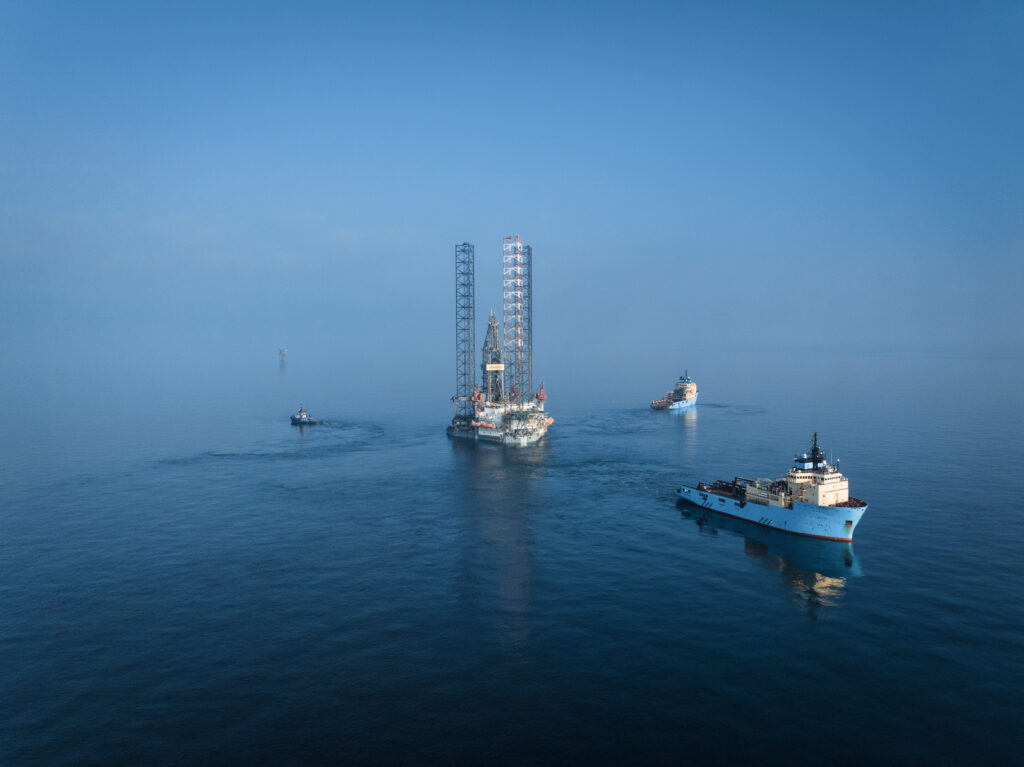
Porthos is a CO2 storage project in which captured CO2 from Air Liquide, Air Products, ExxonMobil and Shell in the Port of Rotterdam area is transported and stored in depleted gas fields beneath the North Sea. Porthos is a partnership between the Port of Rotterdam, Gasunie and EBN. In total, Porthos will store approximately 37 million tonnes of CO2. This equals around 2.5 million tonnes of CO2 per year over a period of 15 years.
Porthos is not expected to become operational before the second half of 2027.
Aramis
The Aramis project is an important part of the broader Aramis initiative. The project involves the development of large-scale CO2 transport infrastructure from the Port of Rotterdam area to enable storage in an initial three storage fields beneath the North Sea. EBN and Gasunie are jointly responsible for its development.
The final investment decision (FID) for Aramis is expected to be taken in 2027, after which the Aramis project can become operational in 2030. The pipeline will have a capacity of 22 million tonnes.
Working together to build the CCS market
CO2 transport and storage is a shared challenge. That is why EBN works closely with industry, energy companies, knowledge institutes and government authorities.
By investing, sharing knowledge and delivering projects, we accelerate the development of CCS in the Netherlands. In this way, we contribute to achieving the climate goals and to a future-proof energy system.