




Responsible CO₂ storage
CO2 storage plays an important role in reducing greenhouse gas emissions. Because we aim to store CO2 permanently, it is essential that this is done responsibly, safely and under controlled conditions. Strict regulations therefore apply, and the safe transport and storage of CO2 are continuously monitored.
Strict regulations
Responsible implementation and due care are essential requirements for CO2 storage. For this reason, strict rules on safety, the environment and project execution apply in the Netherlands. From the start of a project, all parties involved must comply with clear legislation and regulations, as well as extensive assessments by various authorities.
CO2 storage requires a comprehensive set of permits and obligations, including:
- Permits under the Mining Act for the storage of CO2 in the subsurface;
- A mandatory Environmental Impact Assessment (EIA), which examines the impact on the environment and surrounding area;
- Natura 2000 permits, emissions permits and environmental permits issued by the relevant authorities;
- Strict requirements for safety and monitoring, both during and after storage.
Responsible CO2 transport
To safely transport CO2 to the right location after it has been captured, a range of factors are closely monitored throughout the transport process. The volume, composition, pressure and temperature of the CO2 are continuously monitored. Pipelines are also inspected regularly so that any irregularities can be detected immediately.
Small quantities of other substances, such as water or methane, may be present in the CO2 stream. These can affect the behaviour of the CO2 or the transport system. For this reason, clear quality requirements apply to the CO2 being transported. In this respect, a CO2 pipeline is very similar to the natural gas pipelines that have been used safely and on a large scale in the Netherlands for many years.
Responsible CO2 storage in depleted gas fields
Depleted gas fields located several kilometres beneath the North Sea are used for CO2 storage. In this context, people often refer to CO2 storage in “empty” gas fields, but this is not entirely accurate. These gas fields are never completely empty; rather, the remaining gas is no longer economically recoverable. Fortunately, this does not prevent CO2 storage. Natural gas and CO2 are molecules that can safely coexist.
The depleted fields have safely contained gas for millions of years and are therefore suitable for long-term storage. Before a site can be used for CO2 storage, extensive studies are carried out to assess the suitability of the field. These studies examine the storage capacity, the presence of sealing geological layers and the condition of the wells. A field is only considered suitable for storage once it has been demonstrated that it is fully sealed and can operate safely.
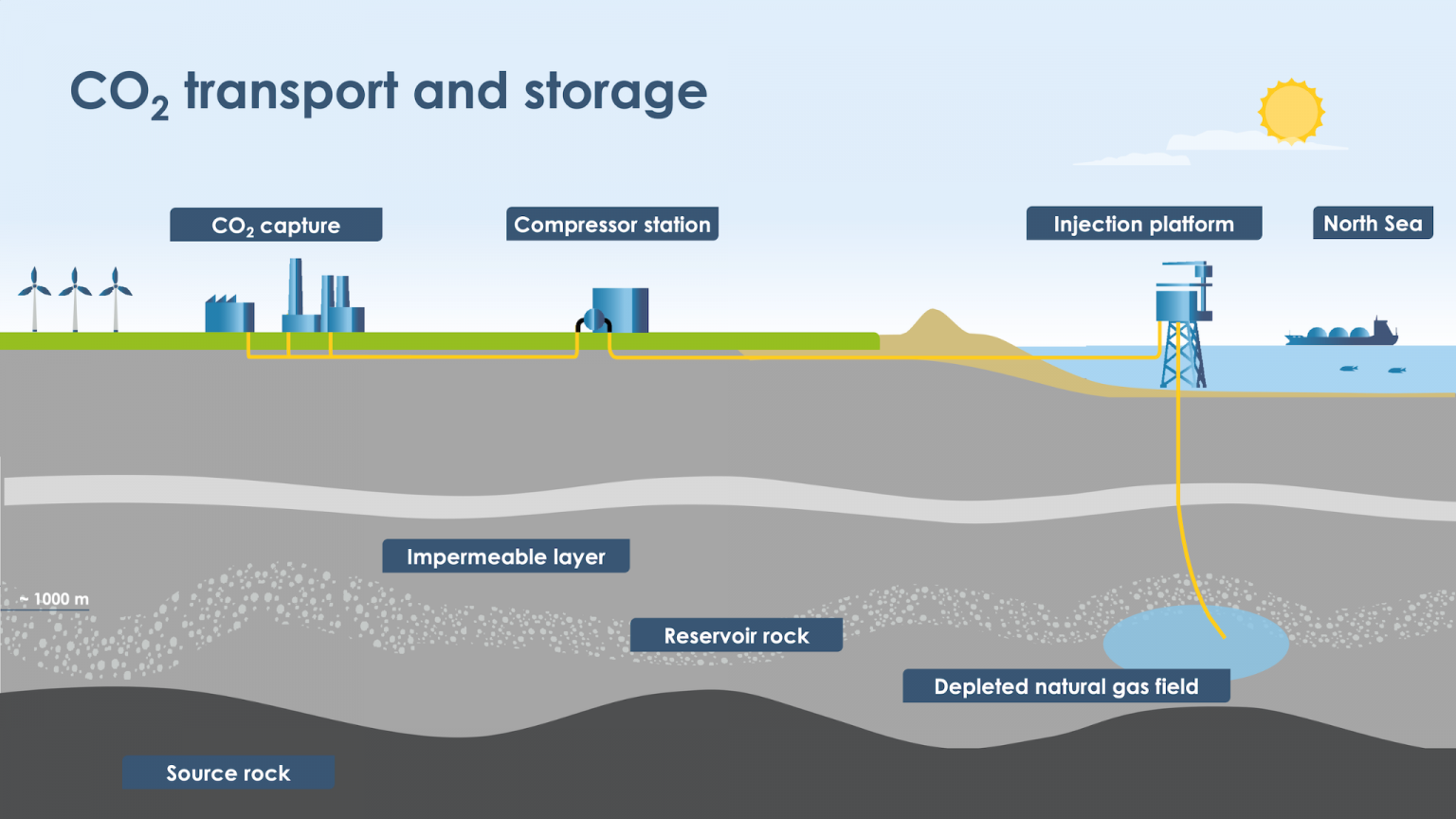 How CO₂ is captured, transported and permanently stored deep underground beneath the North Sea.
Technical measures and monitoring
The technical condition of the wells, also referred to as integrity, plays a crucial role in CO2 storage. The wells are thoroughly inspected and, where necessary, modified to make them suitable for CO2 injection. All new well components are made from materials that are resistant to CO2.
Once the CO2 has been stored, operational procedures are used to control the temperature of the CO2 and the pressure within the system. This ensures that the CO2 remains at the appropriate temperature to prevent risks such as the freezing of system components and to maintain proper flow through the system.
Monitoring during and after storage
The safety of CO2 storage is ensured not only before and during injection, but also afterwards. During and after storage, the system is continuously monitored for any leakage, for the balanced distribution of CO2 within the gas field, and for any seismic activity.
CO2 storage in aquifers
In addition to CO2 storage in depleted gas fields, research is being conducted in the Netherlands into CO2 storage in aquifers beneath the North Sea. An aquifer is a water-bearing layer in the subsurface consisting of porous rock or sediment, such as sand or gravel. In several countries, including Norway, the United States and Australia, aquifers are already being used for large-scale CO2 storage. In the Netherlands, this is currently still under investigation, and EBN is also involved in this research.