




Stakeholder engagement and collaboration
For EBN as a public energy company, collaboration with stakeholders is essential. EBN delivers its projects and activities in close partnership with a wide range of stakeholders.

As EBN operates at the intersection of government, industry and society, maintaining an ongoing dialogue with a broad and diverse range of stakeholders is both natural and essential.
EBN continuously monitors developments across its stakeholder landscape and maintains regular engagement with relevant parties. This stakeholder collaboration supports the exchange of knowledge, enables open discussions about interests and concerns, and helps identify joint solutions to the challenges of the energy transition. These interactions take place through regular consultations, knowledge-sharing events, industry associations and project-specific discussions.

Use the form below to contact Monique Wesly, Manager Communications and Public Affairs.
"*" indicates required fields
Stakeholderonderzoek 2025
Stakeholder survey
To maintain an active dialogue about mutual expectations and stakeholder experiences, EBN periodically conducts a stakeholder survey. The survey was carried out for the fourth time in 2025. Its purpose is to assess how stakeholders value EBN as the public energy company for the Netherlands and to identify opportunities to further strengthen collaboration.
EBN engages with an increasingly broad range of stakeholders. More than 900 stakeholders from various groups were invited to participate in the survey. The results show that stakeholders value EBN for the way we collaborate, create societal and financial value, and operate professionally. At the same time, the survey provides valuable insights into areas where further improvement is possible.
The findings serve as an important foundation for more in-depth follow-up discussions with stakeholders. In this way, EBN continues to learn from practical experience and strengthen its role in the energy transition.
Stakeholders and the double materiality assessment (DMA)
Stakeholders also play an important role in the double materiality assessment (DMA). Through this assessment, EBN determines which sustainability topics are most relevant to the organisation, its environment and its stakeholders.
When conducting the DMA, EBN involves both internal and external stakeholders. Employees and other internal stakeholders contribute insights based on their expertise and knowledge of the value chain. External stakeholders are consulted to help identify relevant topics, opportunities, risks and areas of impact. Through more in-depth discussions, they share their perspectives on the issues they consider most important for EBN and the energy transition.
The insights gained from these discussions are incorporated into the assessment and prioritisation of material topics. In this way, EBN ensures that its objectives, policies, projects and reporting reflect not only internal considerations, but also societal expectations and external perspectives.
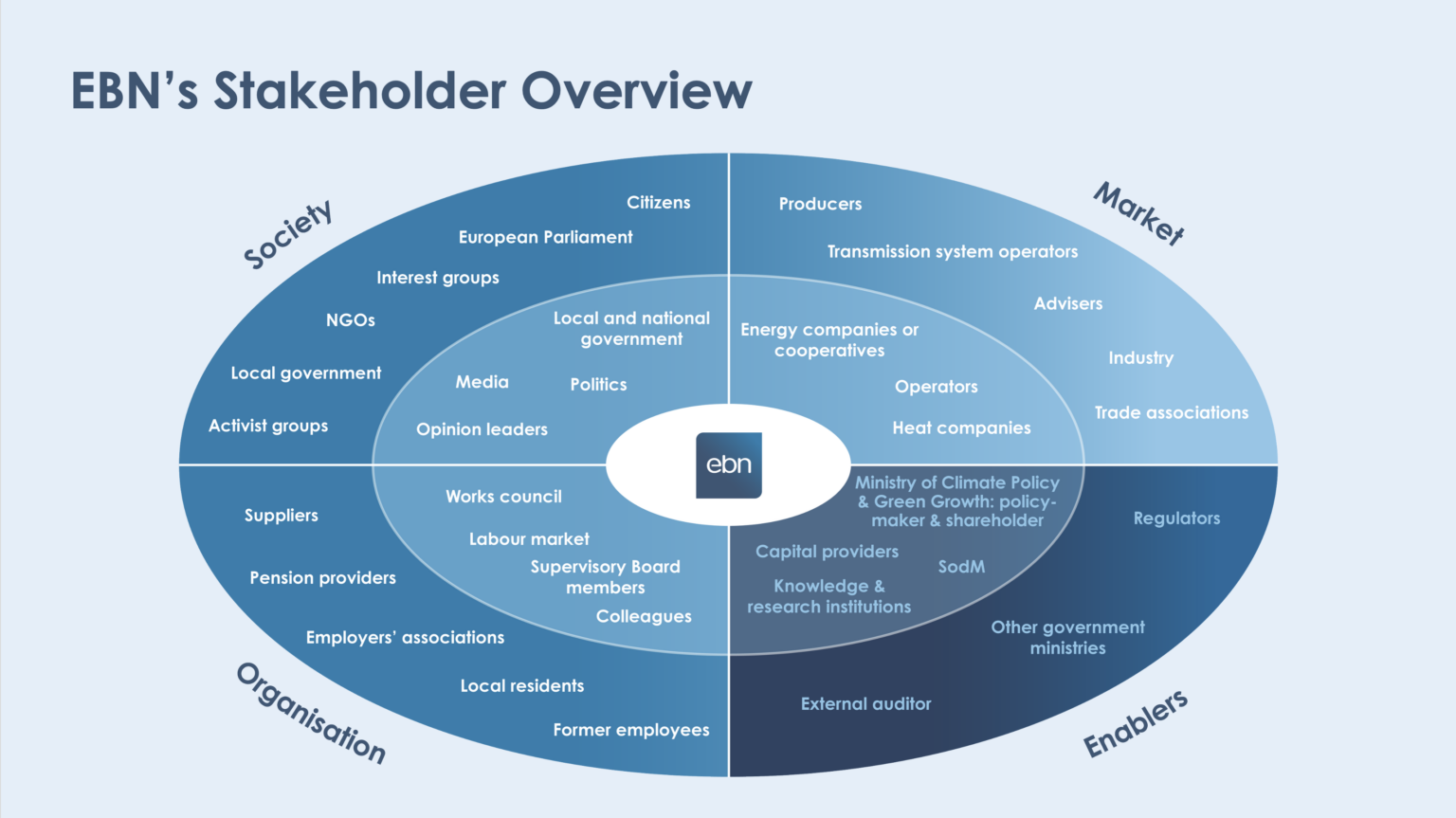 EBN’s stakeholder landscape illustrates the societal, market, organisational, and institutional stakeholders that EBN engages with and takes into account in delivering its public energy mission.
Collaborations
EBN works with a wide range of stakeholders. We distinguish four stakeholder groups:
- Society: governments, policymakers, interest groups, media and opinion leaders
- Market: energy companies, grid operators, heat companies and other organisations across the energy value chain
- Organisation: employees, supervisory board members, the works council, and organisations involved in the wellbeing of current and former employees
- Enablers: ministries, financiers, knowledge institutions and regulatory bodies
Each stakeholder group requires its own approach to collaboration, but the objective remains the same: working together towards a reliable, affordable and sustainable energy system for the Netherlands.
In summary: working together on sustainable solutions
By involving stakeholders at an early stage, EBN fosters greater mutual understanding, helps identify risks sooner, and enables solutions to be developed collaboratively. In this way, stakeholder collaboration contributes to broad support, better decision-making, and the successful delivery of projects that advance the energy transition.