




How does district heating work?
District heating is a way to heat homes and offices without natural gas. A district heating network is a collective system in which heat is generated centrally. This heat is transported to homes and buildings through a network of underground pipes
Heat supplied through a district heating network is used for the heating of buildings and domestic hot water. The system always serves several users at the same time, ranging from hundreds to thousands of connections per network. This is why it is also referred to as a collective heat supply. District heating is an important part of the energy transition in the built environment.

Use the form below to contact Marijn Renting, Manager Business Development Heat (NDW).
"*" indicates required fields
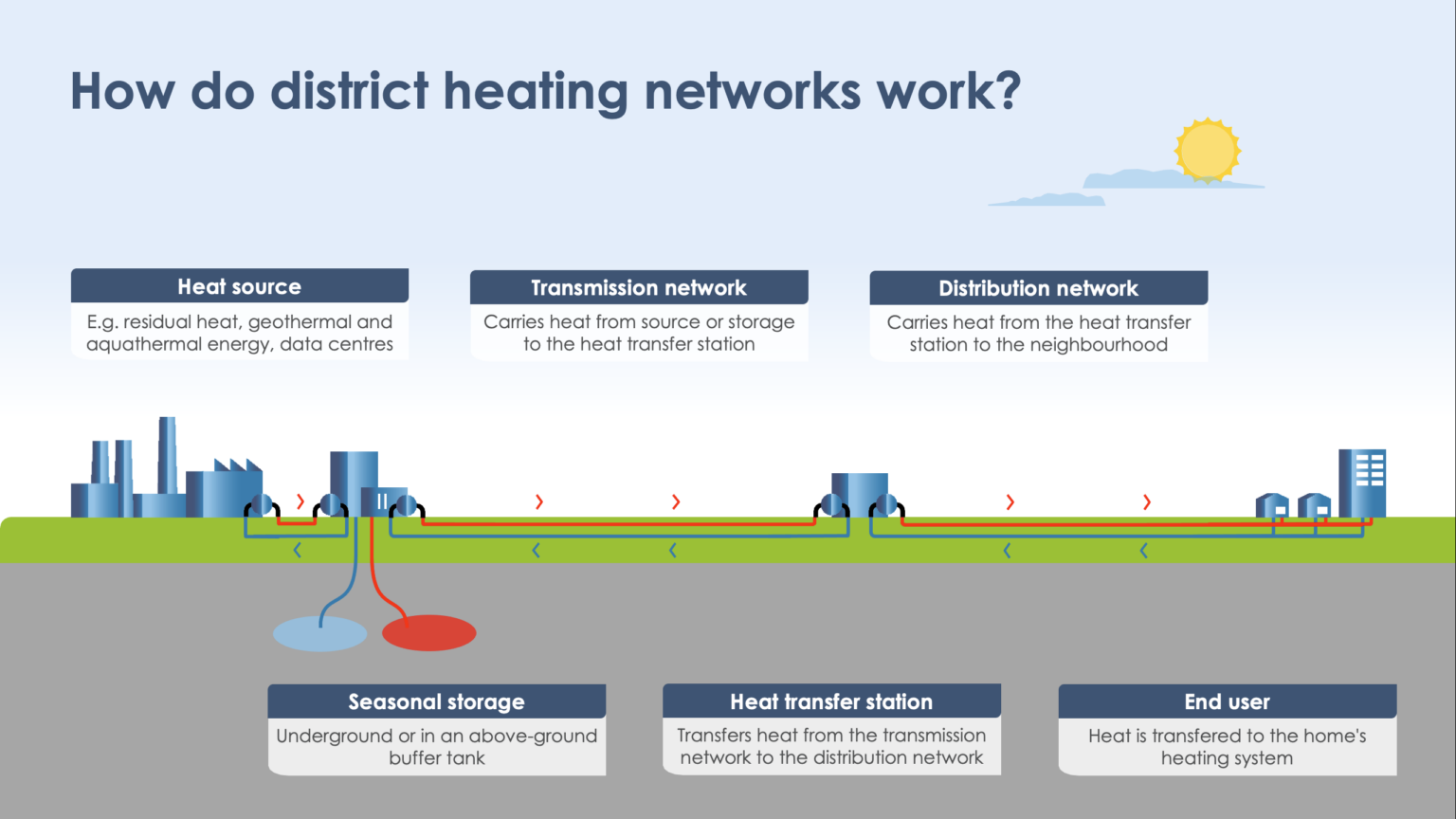 How district heating networks deliver sustainable heat from local sources to homes and buildings.
How does a district heating network work?
In a collective heat network, heat from one central source or several decentralised sources is used. Hot water flows through insulated pipes to a neighbourhood or business park. Instead of an individual central heating boiler, a building or home receives heat through its connection to the heat network. In the building or home, a heat exchanger transfers the heat from the heat network to the heating pipes in the building. In this process, the water in the heat network cools down. This cooled water then returns to the source to be heated again.
Which heat sources are used?
The strength of district heating lies partly in their ability to use different sustainable heat sources. Examples of sources used in the Netherlands include geothermal energy, aquathermal energy, residual heat from industry and heat from waste processing. To us the aim is always to use local sources as efficiently as possible and to match heat demand and supply effectively.
Why is district heating important in the Netherlands?
District heating plays a crucial role in the heat and energy transition of the Netherlands. In densely built-up areas, individual solutions such as heat pumps are often technically or spatially difficult to integrate into existing homes. Collective heat offers economies of scale, reliability and efficient use of sustainable sources. District heating also contributes to the energy security of the Netherlands. For these reasons, district heating is an important part of the Dutch future energy system.
District Heating in the Netherlands
Is a heat network connection cheaper than a heat pump?
Whether a district heating network is more cost-effective than a heat pump depends on several factors, including the type of dwelling, the level of insulation, and the available space within the building. As a result, a district heating network may be the best option in some cases, while a heat pump may be preferable in others. However, from a societal perspective, switching an existing neighbourhood exclusively to heat pumps can be more expensive than connecting it to a district heating network. This is due to the investments required to reinforce the electricity grid and prevent grid congestion. In addition, individual systems such as heat pumps generally have a shorter technical lifespan than collective district heating networks, which are designed to operate for several decades.
For district heating networks, costs vary depending on the heat source, the size of the network, and local circumstances. As a result, operating costs may differ between municipalities or neighbourhoods, even when the same heat company operates multiple networks. In some municipalities, a decision is made to apply a single tariff across all networks, despite differences in operating costs.
EBN and district heating
Energie Beheer Nederland (EBN) contributes to the development of district heating by sharing knowledge and expertise and by stimulating cooperation. To this end, the Ministry of Climate Policy and Green Growth has housed the National Heat Investor (Nationale Deelneming Warmte – NDW) within EBN as a separate policy participation. From the public interests of affordability, security of supply and sustainability, the National Heat Investor supports the scaling up of sustainable heat sources and the responsible design of collective heat systems as an investor in public heat companies. NDW is also the vehicle through which the Dutch government would like to procure the currently privately held district heating activities of Eneco, Ennatuurlijk and Vattenfall.